Match Factory!
- 4.7
- Rating
- 10.00M
- Installs
- Free
- Price

 Analysis by App-foxy
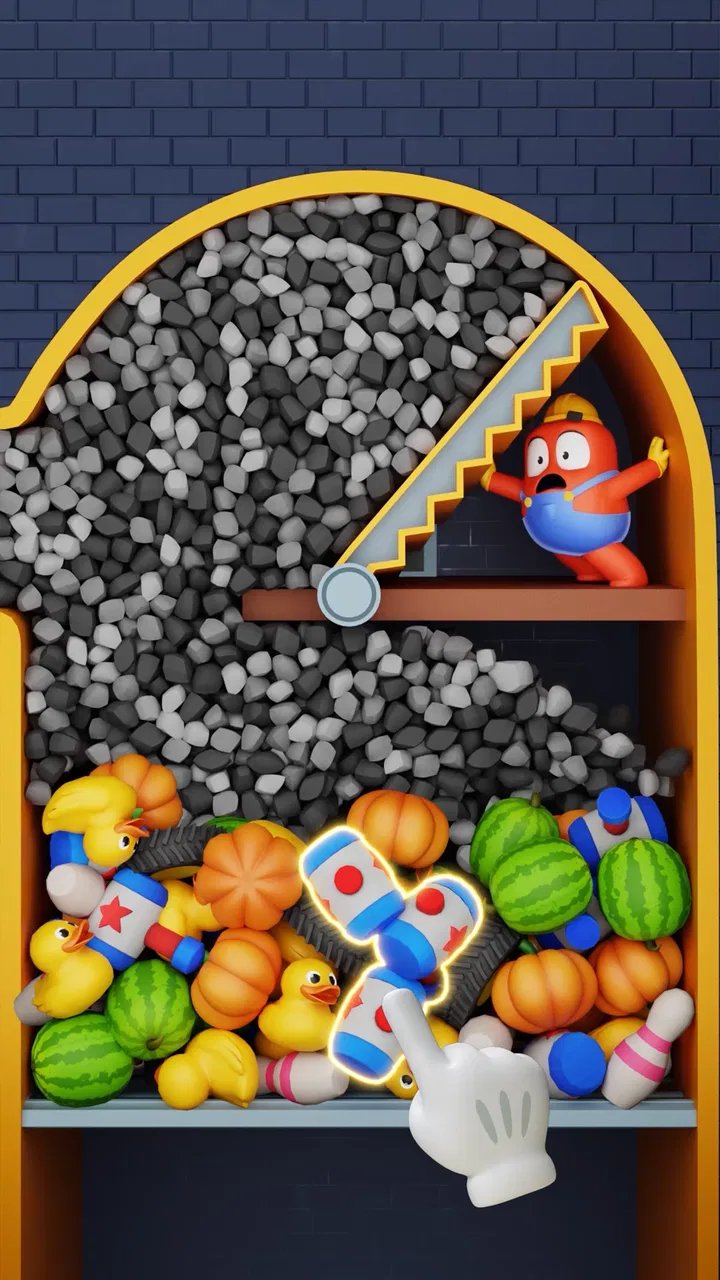
I spent time with Match Factory! as a casual puzzle game, and its main appeal became clear quickly: it turns the familiar act of finding matching objects into a three-dimensional sorting challenge. Instead of simply swapping colored pieces or clearing a flat board, I had to scan a busy scene, recognize groups of three, and decide which objects were worth picking up first. That small change makes each level feel more like a visual search task than a traditional match-three game.
That focus is what gives the game its identity. It is easy to understand within a few moments, but the board can still make me pause when several similar items are mixed together. I would recommend it to someone who enjoys short puzzle sessions, visual organization, and the satisfaction of gradually clearing a cluttered space. I would be more cautious with it for players who want a deep story, competitive strategy, or completely uninterrupted play without purchase prompts.
Why the three-dimensional matching idea works
The central capability is straightforward: locate three matching objects and combine them before the available space becomes difficult to manage. In practice, the challenge is not just identifying a pair of objects that look alike. I also have to notice what is partly hidden, judge which item is accessible, and avoid filling my selection area with pieces that do not immediately help.
You May Also Like

 Blood Strike: 2.5 Anniversary
Blood Strike’s Loadouts Turn Every Drop Into a Tactical Gamble
A close look at Blood Strike’s custom loadouts: how fast access to signature weapons reshapes its battle royale rhythm, rewards preparation, and narrows the gap between fights.

 Pandora - Music & Podcasts
Pandora’s Music Is Easy to Start, but Harder to Recover
Pandora’s strength is its low-effort path from a seed to a station. Its weak spot is how much confidence it asks you to place in connection, setup, and quiet recovery.

 8 Ball Pool
 Is Built on Rivalries, Rematches, and Routine
A close look at the rivalries, rematches, shared routines, and unanswered safety questions that turn a quick pool match into a persistent mobile community.

 Samsung Music
’s Quiet Strength Is Playing What You Already Own
Its reach comes less from spectacle than from dependable access to a personal library. That simplicity is both the app’s strongest retention engine and its ceiling.

 AccuWeather: Weather Radar
AccuWeather Review: A Quick, Clear Forecast for Everyday Decisions
For everyday plans, the best forecast is the one you can understand quickly. AccuWeather makes rain timing, radar, and local conditions easy to act on, with a few trade-offs.

 Hill Climb Racing
Why Hill Climb Racing Still Turns Crashes Into One More Run
A tiny car, a bumpy hill and one more upgrade: Hill Climb Racing keeps resurfacing because its simple chaos makes every near-miss feel personal.
More From Our News Desk



That creates a useful layer of planning. A quick choice can make the next few moves easier, while an attractive but premature match can leave awkward objects blocking the board. I found myself looking beyond the obvious group and asking which selection would reveal more of the scene. This is the kind of decision that separates the game from a purely reflex-based matching title.
The 3D presentation matters because it changes how I read the puzzle. Objects are not arranged as a simple, perfectly visible grid. I need to inspect the whole arrangement and mentally track which pieces belong together. The result is gentler than a timed action game, but it still rewards attention. When I am tired, I can play casually; when I want to solve a level efficiently, I need to slow down and plan.
Peak, the developer, has built the experience around that single idea rather than burying it under complicated controls. The game is free to start, which makes it easy to test without committing to a purchase. It is rated for Everyone, so its presentation is approachable for a broad audience. The current version is 1.61.39, and it runs on Android 7.0 or later, making it accessible on many older devices as well as newer phones.
The game’s popularity also suggests that the format has found a wide audience: it has passed ten million installs and holds an average rating of 4.7 from roughly 606 thousand ratings. I do not treat popularity as proof that every player will enjoy it, but those figures fit my impression that the basic loop is immediately understandable and easy to return to.
What I actually do during a level
I begin by scanning the visible objects rather than tapping the first familiar item I see. If three matching pieces are already easy to reach, taking them can be sensible, but I do not always choose that route. Sometimes a less obvious object is the key to exposing several useful pieces underneath. The best move depends on how much room remains in the temporary selection area and how many future matches I can already anticipate.
This makes the game surprisingly good for short breaks. A realistic use case is a few minutes while waiting for an appointment or sitting on a train. I can open it, complete some puzzle progress, and stop without needing to remember a complicated storyline. The same structure also works after a long day when I want something interactive but not mentally exhausting.
My most useful habit was to treat the lower selection area as a limited resource rather than a place to store random objects. If I pick up one item from several unrelated groups, I may create a pile that is harder to resolve than the original board. I get better results by committing to one or two likely triples and checking whether a move will uncover another matching object before adding something new.
A second helpful habit is to search in layers. I first look for fully visible triples, then inspect the edges of the arrangement, and only afterward spend time on objects that are partly covered. This reduces wasted taps and helps me form a mental map of the level. It is a small technique, but it makes the difference between playing by impulse and playing with a plan.
I also learned not to confuse visual similarity with a guaranteed match. In a crowded 3D scene, nearby objects can look related even when they are different pieces. I now check shape and detail before using a selection slot. That is particularly important when the board is nearly full, because one mistaken tap can turn a comfortable puzzle into a recovery exercise.
The most satisfying scenario for this game
The strongest setting for Match Factory! is a short, quiet session where I want a puzzle with a clear goal and immediate feedback. It fits people who like tidying, spotting patterns, and completing small tasks one after another. The act of removing groups from a busy arrangement gives a mild sense of order, which is more satisfying than a simple score counter for me.
It is also a good choice for players who find standard match-three games repetitive. The familiar idea of making groups remains, but the visual search and object placement make each board feel more hands-on. Someone who enjoys hidden-object games may appreciate the observation involved, while a fan of sorting puzzles may like the need to manage the selection area carefully.
Families may find the Everyone rating reassuring, and the basic rules are simple enough to explain without a tutorial session. Still, I would not assume that every young player will find it equally easy. Recognizing objects is only the first step; planning around limited space requires patience. For a child, the game can be a relaxed matching activity, while an adult may approach the same board as a small optimization problem.
For me, the best routine is to play in deliberate bursts rather than leave it running endlessly. I look for a few safe matches, use the board’s changes to reassess the situation, and stop when the experience begins to feel repetitive. This keeps the central capability enjoyable instead of turning it into background tapping.
Where the design creates friction
The same simplicity that makes the game welcoming can also limit it. The core action is easy to learn, so players looking for substantial strategic variety may eventually want more than matching and clearing. The challenge comes from arrangement and decision-making, not from a large set of radically different rules. If I want a puzzle with story progression, elaborate mechanics, or a strong competitive layer, I would choose another category of game.
There is also a difference between “relaxing” and “effortless.” The board can become visually busy, and repeated scanning may be tiring on a smaller phone. I sometimes needed to pause and inspect the scene instead of relying on quick recognition. Players with limited patience for visual clutter may prefer a cleaner tile-matching game with a flat layout.
Because it is free to download, the game follows the familiar free-to-play model, including optional in-app purchases ranging from $0.99 to $199.99 per item. That wide range is worth noticing before installing. I can begin without paying, but anyone who is sensitive to purchase prompts or prefers a single upfront price should approach it carefully. I would also set device-level purchase protections if a child will be playing.
The game is not the best fit for someone seeking a fully offline, distraction-free puzzle routine unless they are comfortable with the way the particular installation behaves. I would also skip it if my priority were a fixed campaign that ends after a defined number of handcrafted stages. Its appeal is the repeatable matching loop, so the question is whether that loop itself is enough to keep me interested.
Another trade-off is that the game rewards careful observation more than rapid tapping. That is positive for thoughtful players, but it means it may feel slow to someone expecting arcade speed. I enjoyed the pause-and-plan rhythm, yet I can see why a player looking for constant motion might lose interest. The game works best when I accept its pace rather than trying to force it into an action format.
How it compares with familiar puzzle alternatives
Compared with a conventional match-three game, this one gives me more direct control over the objects I am collecting. There is less emphasis on arranging a falling grid and more emphasis on recognizing groups in a layered scene. That makes it feel closer to sorting and visual search than to a classic jewel-swapping puzzle.
Compared with a hidden-object game, the goal is more structured. I am not simply searching for a long list of items; I am looking for sets of three and managing the consequences of each selection. This gives the session a clearer rhythm and a stronger sense of immediate progress, although it may offer less variety in the type of observation required.
Compared with a pure sorting game, the matching rule adds uncertainty. I cannot always organize everything in a neat sequence because the useful objects may be partially blocked or separated across the scene. That extra uncertainty is where much of the challenge comes from. If I enjoy arranging objects into categories but dislike surprise obstacles, a simpler sorting title may be a better fit.
Compared with a paid premium puzzle, the free entry point is convenient, but the purchase structure changes the experience. A premium alternative may be preferable for someone who wants to pay once and avoid optional spending decisions. On the other hand, the free model lets me try the central mechanic first and decide whether it deserves a place on my phone.
Who gets the most from the experience
I think the biggest audience is made up of casual puzzle players who want a game that explains itself quickly but still gives them small decisions to make. It is especially suitable for people who enjoy visual clutter being transformed into order, and for anyone who likes a game that can be played in short sessions without requiring a long setup.
It may also suit players who are moving away from fast reflex games. The important skill is noticing and planning, not reacting to enemies or memorizing complex controls. I can play at my own pace, examine the board, and make a move when I am ready. That makes it a comfortable choice for relaxed daily use.
I would recommend caution for players who dislike free-to-play monetization, become frustrated by crowded visuals, or need every level to introduce a new mechanic. The game’s strength is concentration on one polished idea, and that is also its main limitation. If the matching loop does not appeal during the first few sessions, additional progress is unlikely to change the fundamental experience.
Storage and compatibility should be easy to assess for many Android users because the minimum requirement is Android 7.0. The game is free, but I would still review purchase settings before handing the phone to someone else, particularly because individual purchases can reach $199.99. That is practical preparation rather than a criticism of the matching design itself.
My final recommendation after playing
Match Factory! succeeds because its central capability has real depth without becoming difficult to explain. Finding triples sounds basic, but the 3D arrangement turns each choice into a question about visibility, space, and timing. I found the most enjoyment when I stopped tapping automatically and started treating the board as a small problem to read and manage.
Its free price makes trying it straightforward, and the Everyone rating broadens its appeal. The strong average rating and large install base are consistent with a game that is easy to pick up, though they should not replace personal taste. Players who enjoy sorting, matching, and visual scanning will probably understand the appeal quickly.
My honest advice is to try it when you want a calm, focused puzzle for short sessions. Use the selection area carefully, search for moves that reveal more of the board, and avoid spending simply to push through a difficult moment unless you are comfortable with the purchase model. If you want a story-driven adventure, a premium no-prompt experience, or fast competitive action, another game will serve you better.
For the right player, the pleasure is simple but genuine: a messy scene gradually becomes clear because I noticed the right objects and made the right decisions. That focused loop is enough to make this a worthwhile free puzzle, provided I enjoy the process as much as the final cleared board.
FAQs for Match Factory!
01What is the main objective of Match Factory!?
Match Factory! is a puzzle game where the primary goal is to match and combine similar items on the board to create new, more complex items. This progression unlocks new levels and challenges, engaging players with its strategic gameplay and vibrant graphics.
02Is Match Factory! available for both Android and iOS devices?
Yes, Match Factory! is available for download on both Android and iOS platforms. You can find it on the Google Play Store for Android devices and the Apple App Store for iOS devices, ensuring accessibility for a wide range of users.
03Are there any in-app purchases in Match Factory!?
Match Factory! offers in-app purchases that allow players to buy additional items, boosters, and lives to enhance their gaming experience. While the game is free to play, these optional purchases can help advance through challenging levels more quickly.
04Does Match Factory! require an internet connection to play?
Match Factory! can be played offline, allowing players to enjoy the game without an internet connection. However, some features, such as leaderboards and in-app purchases, will require connectivity to function properly.
05What age group is Match Factory! suitable for?
Match Factory! is designed to be family-friendly and is suitable for players of all ages. The game's intuitive mechanics and colorful design make it accessible for children, while the strategic elements provide a challenge for adults as well.
Pros
- Engaging puzzle mechanics.
- Vibrant and colorful graphics.
- Smooth and intuitive controls.
- Regular updates with new levels.
- Offline play available.
Cons
- In-app purchases can be expensive.
- Occasional ads disrupt gameplay.
- Limited lives can be frustrating.
- Some levels feel repetitive.
- Requires frequent internet connection.

Match Factory!
Gallery